

You're standing in the lobby of a busy Manhattan hospital, watching the clock while your loved one waits in a wheelchair nearby. The discharge papers are signed, but the final hurdle is just beginning. Finding reliable hospital discharge transportation NYC isn't just about booking a ride. It's about ensuring a vulnerable person moves through the city's chaotic traffic without the risk of a fall or the discomfort of a cramped vehicle.
You've spent days focusing on medical recovery, and now the logistical burden of the trip home feels heavy. It's natural to feel stressed about whether a driver will arrive on time or if they'll have the patience to handle physical limitations with care. This guide simplifies that transition by helping you select and coordinate professional, wheelchair-accessible transportation that prioritizes safety and dignity. We'll explore how to vet providers for their mobility expertise, manage pickup timing to avoid hospital wait fees, and ensure a seamless journey from the bedside to your front door.
Key Takeaways
- Understand how specialized NEMT bridges the gap between clinical care and home recovery, ensuring the final 50 feet to your living room are handled with professional care.
- Learn to evaluate hospital discharge transportation NYC providers by looking for ADA-compliant vehicle features and drivers trained in mobility assistance rather than just standard curbside service.
- Discover why standard taxis and rideshares often fall short for vulnerable patients, including the safety risks of non-specialized vehicles and the potential for last-minute cancellations.
- Master the timing of your exit by coordinating early with hospital discharge planners to align ready-to-go times with your transport arrival.
- Gain the peace of mind that comes from a seamless, door-to-door transition that prioritizes patient comfort and eliminates the stress of managing city traffic alone.
Understanding the Challenges of Hospital Discharge Transportation in NYC
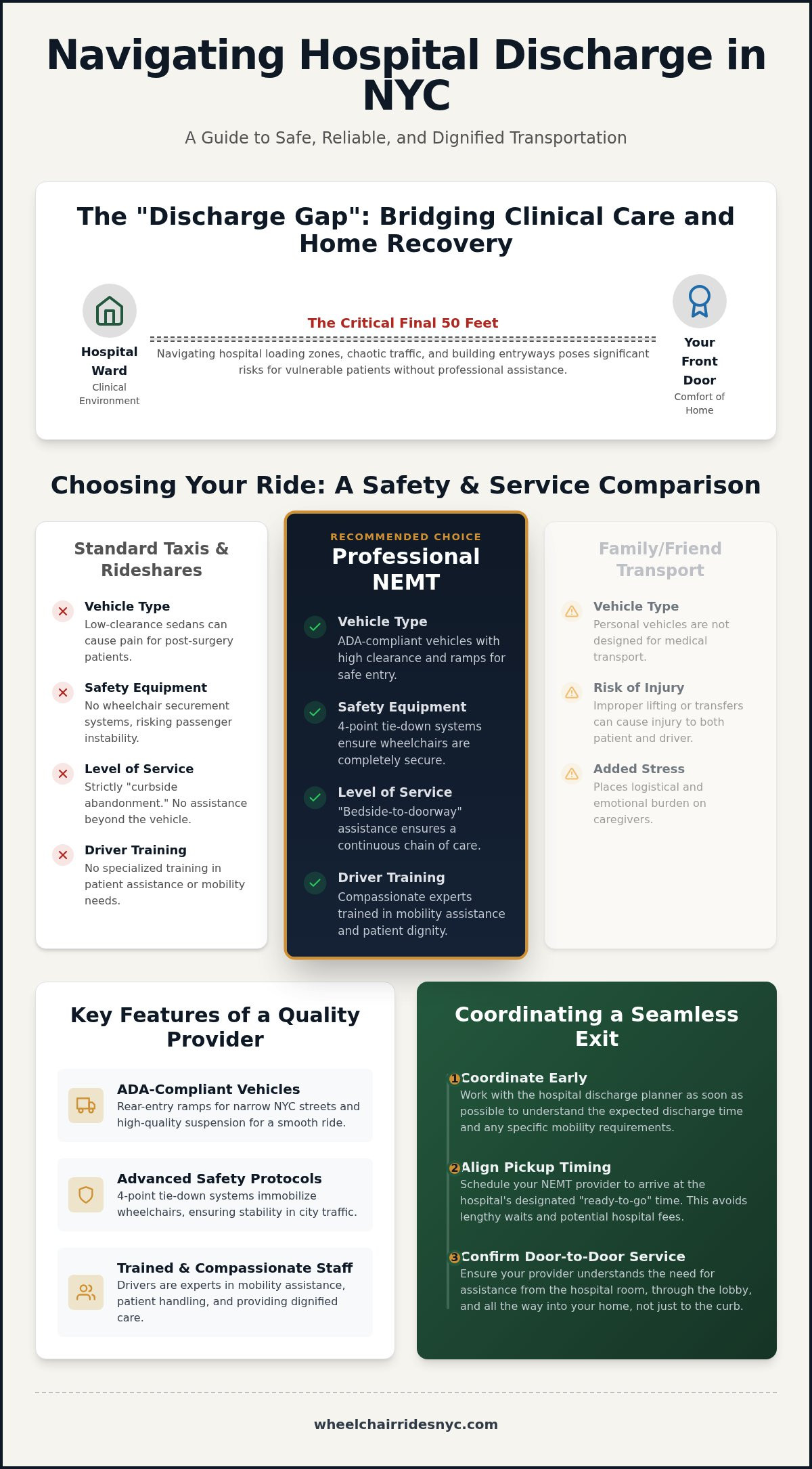
Hospital discharge is much more than a simple exit from a building. It represents a vital medical transition that requires specialized care to ensure recovery continues uninterrupted. Non-Emergency Medical Transportation (NEMT) serves as the essential bridge between the clinical environment of the ward and the comfort of your home. This service addresses the "Discharge Gap," which is the critical final 50 feet from the hospital curb to your living room. In a city as complex as New York, this gap can be the most dangerous part of the journey if not managed by experts.
Navigating Patient transport services in the five boroughs involves unique hurdles that go beyond basic driving. Professional providers must manage chaotic hospital loading zones, heavy gridlock, and the logistical puzzle of NYC walk-up apartments. For a patient who is already physically vulnerable, these obstacles aren't just inconveniences. They are genuine medical risks. Selecting the right hospital discharge transportation NYC ensures that the safety protocols established by doctors are maintained until the patient is safely inside their residence.
Why a Standard Ride Isn't Enough for Post-Hospital Recovery
Standard rideshare vehicles or taxis are built for speed and convenience, not for medical recovery. A low-clearance sedan often forces post-surgery patients into awkward, painful seating positions that can strain sensitive incisions or joints. There's also the significant issue of equipment securement. A folded wheelchair tossed in a trunk offers no stability for the passenger during the trip. Perhaps most concerning is the problem of "curbside abandonment." Standard drivers are generally restricted from leaving their vehicles, which leaves a vulnerable person alone on a sidewalk, struggling to navigate an elevator or a building entrance without help.
The Role of Professional NEMT in the Recovery Journey
Professional hospital discharge transportation NYC providers maintain a "chain of care" that mirrors the hospital's own standards. This transition is methodical and unhurried, which helps reduce the intense anxiety many patients feel when leaving a supervised setting. By choosing a specialized service, you ensure that every detail of the trip supports the healing process.
- Equipment Accommodation: Specialized vans are designed to transport essential medical equipment, such as portable oxygen or monitors, safely and securely.
- Physical Support: Drivers provide bedside-to-doorway assistance, which eliminates the physical strain of entering and exiting the vehicle.
- Patient Dignity: Using ADA-compliant vehicles allows passengers to remain in their wheelchairs, preserving their comfort and personal boundaries throughout the ride.
This level of preparation transforms a potentially stressful ordeal into a steady, predictable experience. It allows caregivers to focus on the patient's emotional well-being while the "Compassionate Expert" handles the complex logistics of the New York streets.
Key Features to Evaluate in an NYC Discharge Transport Provider
Selecting a provider for hospital discharge transportation NYC requires a close look at both technical specifications and the human element. You aren't just booking a vehicle. You're choosing the team that will handle your loved one's safety during a period of physical vulnerability. It's essential to look beyond a simple ramp and evaluate the comprehensive safety protocols a company has in place. A truly professional service treats the journey as a clinical extension of the hospital stay, ensuring that every detail supports the patient's recovery and dignity.
ADA-Compliant Vehicles and Specialized Safety Equipment
In the tight confines of New York City, the type of vehicle matters. Rear-entry ramps are often superior for city streets because they allow the driver to load and unload safely in narrow spaces where parked cars would block a side-entry ramp. Once inside, the security of the wheelchair is the top priority. A reliable provider uses a 4-point tie-down system. This equipment ensures the wheelchair remains completely immobile, even during the sudden stops and starts typical of Manhattan traffic. Comfort is also a medical necessity. High-quality suspension systems and dedicated climate control help manage a patient's pain levels by providing a smooth, temperature-regulated environment that prevents physical jarring or overexposure to the elements.
The 'Compassionate Expert' Driver: More Than Just a Chauffeur
A driver's technical certifications, such as CPR and First Aid training, are the foundation of a safe ride. However, the "Compassionate Expert" persona goes much further. These professionals understand personal boundaries and maintain patient dignity during every physical transfer. They are also trained in sensitivity, recognizing that a patient may be tired, in pain, or anxious about leaving the hospital. This expertise includes a high level of patience. Hospital discharges are notoriously unpredictable, and paperwork delays are common. A dedicated driver doesn't just wait; they stay in constant communication with caregivers, providing real-time updates so the family can coordinate the patient's arrival at home without unnecessary stress.
The final distinction of a quality provider is the level of assistance they offer. Many standard services only provide "curb-to-curb" transport, which leaves the caregiver to manage the difficult transition from the sidewalk into the home. Choosing door-to-door medical transportation ensures the driver provides bedside-to-doorway assistance. This comprehensive support means the driver is physically present to help navigate elevators, hallways, and entryways, ensuring the patient is safely settled before the job is considered complete. This end-to-end care is what makes hospital discharge transportation NYC a reliable solution for families in need.
NEMT vs. Taxis and Rideshares: A Cost-Benefit Analysis
When families weigh the options for hospital discharge transportation NYC, the choice often comes down to perceived cost versus actual safety. Standard transportation apps might seem like a budget-friendly solution, but they aren't designed for the complexities of a medical transition. A specialized NEMT van provides 4-point tie-down systems and ADA-compliant ramps. These features ensure the wheelchair is an integrated part of the vehicle's safety structure. In contrast, a standard SUV offers no such securement. This turns a mobility device into a potential hazard during a sudden stop in city traffic.
The financial comparison also involves looking at liability and insurance coverage. Professional NEMT providers carry commercial insurance specifically designed for patient transport. This coverage protects the passenger from the moment they leave the bedside until they are safely inside their residence. Personal insurance or the limited policies provided by rideshare companies often have "gray areas" when it comes to medical assistance. Choosing a professional service ensures that if an incident occurs during a physical transfer, the patient is fully protected by a provider held to high industry standards.
The Risks of Using Standard Transportation Apps for Discharge
NYC drivers for major rideshare platforms frequently cancel trips when they see a wheelchair on the curb. This leads to "hidden costs" in the form of cancellation fees and the emotional toll of being stranded at a hospital entrance. These drivers generally lack the training required to assist a patient with limited mobility. They operate under a "curbside-only" model. This means they won't leave their vehicle to help a patient navigate a building entrance or a flight of stairs. For a caregiver, this lack of support creates a dangerous situation where they must manage the patient's physical weight and equipment entirely alone.
Evaluating the Investment in Professional Transport
Think of professional transport as a way to avoid the "cost of failure." The financial and physical price of a single fall or a strained surgical incision due to improper seating far outweighs the investment in a specialized ride. By hiring experts, you also significantly reduce caregiver burnout. You can focus on being a supportive family member while the driver handles the heavy lifting and logistical navigation. Reliability is another key factor. While on-demand apps fluctuate based on driver availability, a scheduled NEMT service provides a guaranteed pickup time. This punctuality is essential for avoiding the wait-time fees that many NYC facilities charge when a patient isn't picked up promptly after being cleared for discharge.
How to Coordinate with Hospital Discharge Planners for a Seamless Exit
A successful transition starts long before the patient reaches the hospital curb. To ensure the process remains stress-free, you must actively manage the communication between the medical staff and your transport provider. Hospital bureaucracy can be slow. By taking a proactive role, you ensure that the professional care provided by the hospital translates into a safe journey home. Following a structured sequence of steps will help you stay organized during this busy time.
- Step 1: Early Notification. Tell the discharge planner about your choice of private transport early in the hospital stay. This prevents the facility from defaulting to public paratransit options that may not offer the same level of door-to-door care.
- Step 2: Time Clarification. Confirm the difference between the "Paperwork-Complete" time and the "Ready-to-Go" time. You want the driver to arrive when the patient is dressed and ready to move, not when the doctor is still finishing notes.
- Step 3: Precise Location. NYC hospitals are often massive complexes with multiple entrances. Provide your transport company with the specific building name, floor number, and room number to avoid any pickup delays.
- Step 4: Bedside Meeting. Arrange for the driver to meet the patient directly at the bedside. This ensures a true door-to-door experience where the patient is never left unattended during the transition.
- Step 5: Home Preparation. Ensure the residential environment is prepped before the vehicle arrives. Clear any clutter from hallways and make sure the entryway is accessible for a wheelchair.
When you're ready to organize a professional exit, you can schedule hospital discharge transportation with our team to ensure every detail is managed with precision.
Essential Questions to Ask Your Hospital Discharge Coordinator
Before you finalize your booking, ask the coordinator if the patient requires a wheelchair for the entire trip or just "step-assist" to enter the vehicle. You should also verify if there's a specific "Discharge Lounge" or a dedicated pickup zone the driver must use. To ensure a smooth transition, the family should have the patient's discharge summary, a current medication list, and their insurance card ready for the driver's arrival.
Managing the Timing: The 'NYC Hospital Window'
Timing a pickup in New York is an art. It's often best to book your hospital discharge transportation NYC for approximately 30 minutes after the expected discharge time. This buffer accounts for the inevitable delays in hospital pharmacy stops or final nurse check-ins. If the doctor is running late, communicate with your transport provider immediately. A professional service understands these fluctuations and will work with you to adjust the schedule. This "Bedside-to-Doorway" promise ensures that there are no gaps in supervision, providing a steady and reliable path back to the comfort of home.
Safe Transitions Home with Wheelchair Rides NYC
At Wheelchair Rides NYC, we believe that the journey home should be the most peaceful part of a patient's recovery. We provide a reliable bridge from the clinical environment to the residence, serving families across all five boroughs. Whether you're traveling from the heart of Manhattan to a quiet street in Staten Island, our team ensures that the transition is steady and secure. Our hospital discharge transportation NYC protocols are specifically designed to prioritize the emotional well-being and physical safety of every passenger. We treat the ride as a supportive experience, not just a mechanical task.
Our "Compassionate Expert" drivers are the heart of this service. They possess the technical skills to manage ADA-compliant vehicles and the empathy required to support a recovering patient. Every van in our fleet is maintained to the highest standards, featuring specialized ramps and securement systems that provide a smooth ride through the city's unpredictable traffic. We take pride in being proactive problem-solvers who handle the difficult logistics so that you can focus entirely on your loved one's comfort.
Professional Bedside-to-Doorway Assistance Across NYC
We maintain strong relationships with major medical centers, including NYU Langone and Mount Sinai, as well as local community hospitals throughout the city. Our service doesn't end at the curb. We specialize in navigating the "Last Mile" of the journey. This includes providing physical assistance through lobbies, into elevators, and directly into the patient's private residence. This end-to-end support eliminates the stress for caregivers and ensures the patient is never left to navigate physical obstacles alone. You can also learn more about our Ambulette services for ongoing medical appointments to maintain your recovery schedule.
Booking Your Safe Ride Home Today
Organizing your ride is a simple, transparent process designed to lower your stress levels. When you contact our dispatch team, we'll ask for a few specific details to ensure the vehicle is perfectly equipped for your needs. Please have the patient's approximate weight, the specific type of wheelchair used, and home access details, such as the presence of stairs or ramps, ready for our team. We also offer flexible scheduling for those who require recurring transportation for physical therapy or follow-up doctor visits. Our goal is to provide a sense of calm reliability during a complex time. Book your hospital discharge transportation with Wheelchair Rides NYC to secure a seamless transition for your loved one.
Ensure a Seamless Transition to Recovery
The journey from a hospital bed to your own front door is a critical phase of the healing process. You've seen how specialized care bridges the gap between clinical safety and home comfort. By prioritizing professional assistance over standard rideshares, you protect your loved one from the risks of improper seating and the stress of curbside abandonment. Navigating hospital discharge transportation NYC with a dedicated partner ensures that every logistical detail is handled with precision and empathy.
Our commitment to your family's well-being includes ADA-compliant vehicles for maximum safety and highly trained drivers who prioritize patient dignity during every transfer. We provide comprehensive door-to-door service across all five NYC boroughs, managing the traffic and building logistics so you don't have to. You can secure a safe, professional ride home from the hospital today and find peace of mind in a steady, reliable transition. You've done the hard work of managing medical care. Now, let us provide the supportive experience your loved one deserves as they return to the comfort of home.
Frequently Asked Questions
How far in advance should I book hospital discharge transportation in NYC?
We recommend scheduling your ride at least 24 to 48 hours before the expected discharge date. While we do our best to accommodate same-day requests, booking in advance ensures that a specialized vehicle is reserved specifically for your needs. For those using Medicaid, keep in mind that the state's broker, Medical Answering Services, generally requires at least 72 hours of notice for non-emergency trips.
Will the driver help my family member into our apartment, or just to the curb?
Our drivers provide full bedside-to-doorway assistance, which means they'll help your loved one directly into their home. We understand that the final 50 feet of the journey are often the most difficult for a recovering patient. Our team is trained to navigate building lobbies, elevators, and hallways to ensure the passenger is safely settled inside their residence before the service is complete.
Can a family member ride along in the transport vehicle?
Yes, we encourage one family member or caregiver to ride along with the patient at no extra charge. Having a familiar face nearby helps reduce patient anxiety and allows you to be present for the entire transition. Our ADA-compliant vans are designed with extra seating to ensure both the passenger in the wheelchair and their companion travel in comfort.
What happens if the hospital discharge is delayed past the scheduled time?
We monitor the discharge process closely and maintain open communication with you throughout the day. If the doctor's rounds or final paperwork are delayed, simply notify our dispatch team as soon as possible. We'll adjust the driver's arrival time to align with the patient's actual "ready-to-go" status, helping you avoid unnecessary wait times or stress.
Does insurance or Medicare cover the cost of private hospital discharge transport?
Insurance coverage for hospital discharge transportation NYC varies widely depending on your specific plan and provider. While Medicaid covers transportation for eligible members through a centralized broker, Medicare often has very strict criteria for non-emergency medical transport. We suggest contacting your insurance carrier directly to understand your benefits and see if they offer reimbursement for private NEMT services.
Are your vehicles equipped for bariatric patients or specialized wheelchairs?
Our fleet consists of ADA-compliant vehicles that are built to handle various mobility equipment, including oversized or specialized wheelchairs. To provide the safest experience, please share the patient's approximate weight and the wheelchair's dimensions when you call. This allows us to dispatch the specific van that offers the most space and the appropriate securement systems for a stable ride.
Do you provide transportation for patients who can walk but need assistance?
We provide comprehensive support for ambulatory patients who don't use a wheelchair but still require physical assistance. Our drivers are experts in "step-assist" techniques, offering a steady hand and careful supervision as the patient enters and exits the vehicle. This service is ideal for those who are physically weak after a hospital stay and cannot safely navigate a standard taxi or rideshare.
Which NYC hospitals do you provide discharge services for?
We provide discharge transportation for all major medical centers and community hospitals across the five boroughs. This includes large systems like NYU Langone, Mount Sinai, and NewYork-Presbyterian, as well as NYC Health + Hospitals facilities. Whether you're leaving a specialized ward in Manhattan or a local clinic in Brooklyn or Queens, our team is familiar with the specific pickup protocols of every major facility in the city.